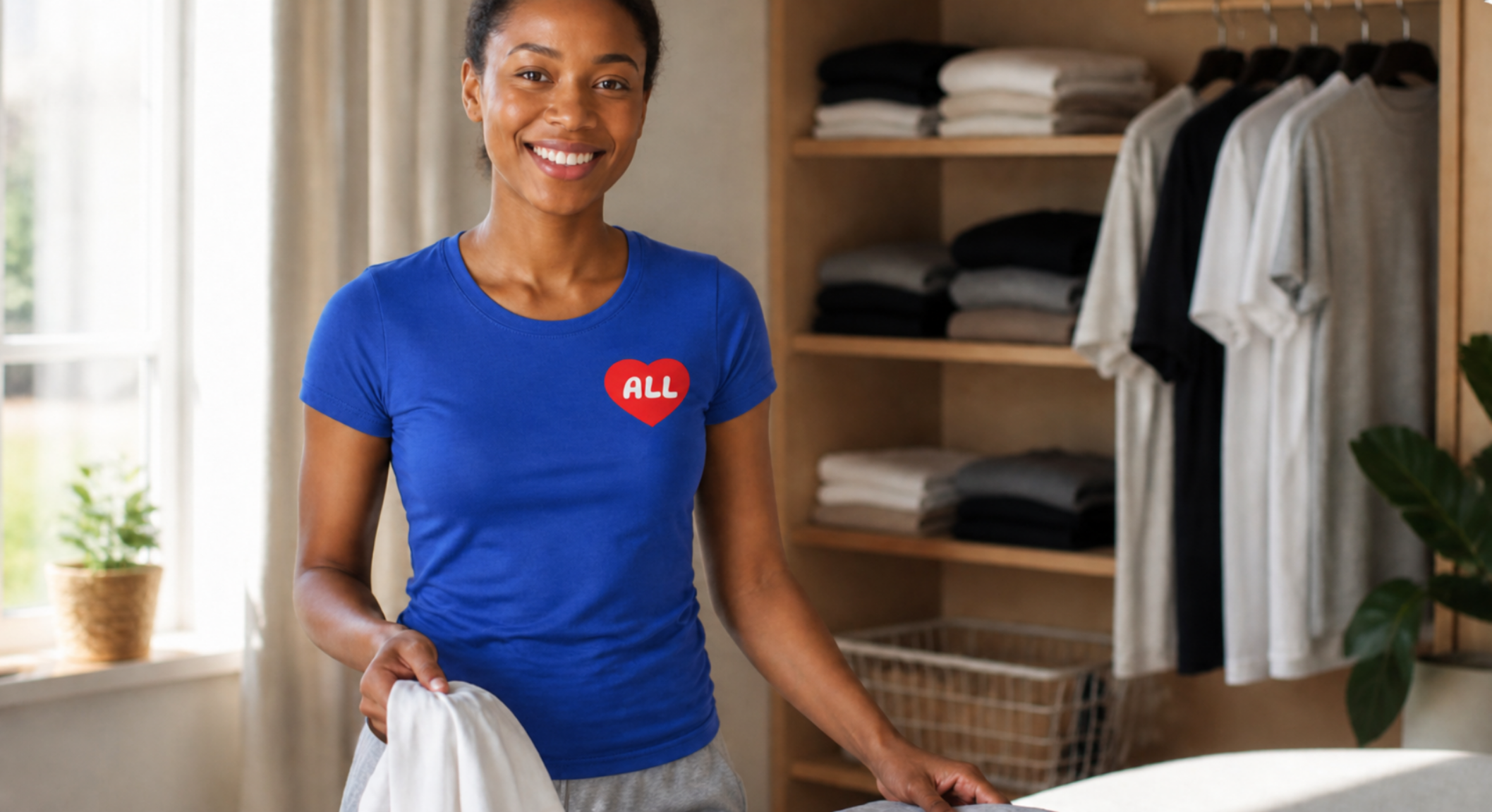
A Woman Wearing the All Love Blue Ladies Tee - Affirmation Apparel by Sawubona Life
Why Tagless Basics Matter More Than You Think
Sawubona. In the isiZulu tradition, it means "I see you," and it carries more weight than a casual greeting. It acknowledges your full worth, your lived experience, and the way you move through the world. That same philosophy drives everything we do at Sawubona Life, because the benefits of tagless basics for adults start with a simple act of recognition: your comfort matters, and the clothing touching your skin all day should honor that.
Here's the thing most people miss. A scratchy tag is not a minor annoyance you should just tolerate. For adults with sensory sensitivities, chronic pain, or skin conditions, that small rectangle of stiff fabric at the back of the neck can trigger a cascade of discomfort that lasts all day. Many adults find that removing that single irritant changes how they experience an entire workday.
This guide breaks down the benefits of tagless basics for adults, from sensory processing support to skin health, and shows you how to choose pieces that actually fit your life.
Key Takeaway: Tagless basics remove the single most common trigger of daily clothing discomfort: the sewn-in label. That one change supports sensory processing, skin health, and mental focus at the same time.
What Are Tagless Basics, Exactly?
Tagless basics are garments where care and size information is printed directly onto the fabric instead of sewn in as a separate label. This eliminates the stiff tag that rubs against the neck, waistband, or side seam.
The term covers more than just T-shirts. Tagless basics include undershirts, underwear, socks with printed sizing, and loungewear. The common thread is label-free printing and a design philosophy that treats the skin's experience as a priority rather than an afterthought.
A few defining features separate true tagless basics from ordinary clothing:
Printed or heat-transferred care information instead of a sewn tag
Soft-touch fabrics chosen for how they feel against skin, not just how they look
Flat-seam construction or seam-free design at high-contact points
Fewer internal labels overall, including on side seams and hems
The difference sounds small. In practice, it's the difference between clothing you forget you're wearing and clothing you're aware of all day.
How Tagless Clothing Helps Sensory Processing
Tagless clothing helps sensory processing by removing a persistent tactile trigger that the nervous system has to filter out continuously. For adults with tactile defensiveness or sensory sensitivities, a sewn-in tag creates a low-grade irritation signal the brain never fully tunes out.
That constant filtering has a cost. Many neurodivergent adults describe it as background noise that drains focus and patience. Remove the trigger, and that mental bandwidth comes back.
Sensory-friendly design extends beyond the neckline. Pressure points matter too. A waistband that digs in, a shoulder seam that sits wrong, or a hem that scratches can each become a source of sensory overload. Tagless basics address the label problem directly, and the better ones also address seams, fit, and fabric weight.
Here's what to look for if sensory processing is your main concern:
No sewn tags anywhere, including side seams and waistbands
Flat-seam construction at the shoulders and underarms
Soft-touch fabrics with a smooth hand feel
Consistent fit so nothing shifts and rubs during the day
Pro Tip: When you're evaluating a garment for sensory comfort, turn it inside out before you buy. Run your fingers along every seam. If you can feel a raised ridge at the shoulder or underarm, that ridge will make itself known by hour three of wearing it.
Sensory-Friendly Clothing for Adults: What Sets It Apart
Sensory-friendly clothing for adults is designed around the wearer's nervous system rather than around trends or cost-cutting. It prioritizes tactile comfort, thermoregulation, and fit consistency over decorative details that add seams, tags, and roughness.
Most mass-market apparel is built to hit a price point. That usually means sewn tags, standard seams, and fabric blends chosen for durability per dollar rather than comfort per wear. Sensory-friendly apparel flips the priority order.

Prosperous Black Unisex Graphic Tee - Affirmation Apparel by Sawubona Life
At Sawubona Life, we build our pieces around this idea. Our tagless apparel uses premium, ultra-soft fabric with label-free printing, so nothing scratches at the neck. All our designs also include subtle sleeve QR codes for quiet advocacy, a discreet way to carry a mindfulness reminder with you. It's a comfort-first design that also supports your mental health journey.
What separates real sensory-friendly clothing from marketing:
Fabric weight and breathability suited to all-day wear
Hypoallergenic materials that reduce reaction risk
Ergonomic design that follows the body instead of fighting it
Consistent sizing so you're not guessing between orders
Skin Irritation, Contact Dermatitis, and Flat-Seam Construction
Flat-seam construction reduces skin irritation by eliminating the raised, bulky seam that rubs against skin during movement. Combined with a tagless design, it removes the two most common mechanical triggers of clothing-related contact dermatitis.
Contact dermatitis is an inflammation of the skin caused by direct contact with an irritant or allergen. Clothing can trigger it through friction, dye sensitivity, or repeated rubbing at seams and tags. The American Academy of Dermatology's overview of contact dermatitis notes that irritant contact dermatitis often develops where fabric and skin meet under pressure.
That's why seam placement matters as much as fabric choice. A thick seam at the shoulder or underarm creates a pressure point that gets worse with every movement. Flat-seam construction lays the seam flat against the fabric so there's no ridge to rub.
For adults managing dermatological comfort, the practical checklist looks like this:
Choose seam-free or flat-seam construction at high-friction zones
Look for hypoallergenic fabrics and dyes
Avoid rough interior finishes and stiff screen prints over seams
Wash new garments before wearing to remove finishing residues
Watch Out: Don't assume "soft" on the outside means soft on the inside. Plenty of shirts feel great in the store but have a stiff, raised interior seam at the shoulder that will irritate skin within hours. Always check the inside surface, not the display side.
The Mental Health Benefits of Comfortable Clothing
The mental health benefits of comfortable clothing come from reduced sensory load. When your clothing stops demanding attention, your nervous system has more capacity for everything else: focus, patience, social engagement, and emotional regulation.
This isn't abstract. Adults with chronic physical limitations or sensory sensitivities often describe clothing discomfort as a tax on their day. Every itch, rub, and scratch pulls attention away from what matters. Removing those triggers is a small change with an outsized effect.
There's also a dignity dimension. Clothing that fits well and feels good supports how you show up in the world. For anyone navigating a mental health journey, that matters. Getting dressed becomes a moment of care rather than a compromise.
This is where intentional design earns its place. A garment can be a daily living aid and a quiet anchor at the same time. The National Institute of Mental Health's resources on stress and daily routines describe how small, consistent routines support emotional regulation over time.
Key Takeaway: Comfortable clothing doesn't just feel better. It frees up mental bandwidth that sensory discomfort would otherwise consume, which supports focus and emotional regulation throughout the day.
SENSORY COMFORT IS IMPORTANT.
ENHANCE YOUR MENTAL HEALTH.
PURCHASE TAGLESS CLOTHING.
Comfort That Lasts: Long-Term Seated Wear and Daily Living
Long-term seated wear exposes clothing weaknesses that standing wear hides. When you're seated for hours, your body weight presses fabric and seams against skin and chair, waistbands dig in, and heat and moisture build up in areas that never get airflow. Tagless basics handle this better because they remove the hard edges that turn pressure into pain.
Why Seated Wear Is Harder on Clothing
Standing, your weight is distributed through your feet, and your clothing hangs loosely. Seated, three things change at once:
Pressure concentrates at the waistband, the back of the thighs, and the lower back, where fabric meets the chair
Friction increases as you shift, slide, and adjust throughout the day
Heat and moisture trap between your body and the seat, because there is no airflow to dry the fabric
A sewn tag or a raised back seam that is invisible while standing becomes a persistent pressure point the moment you sit down. That is the mechanism most guides never explain.
What to Look for in Seated-Wear Basics
Adults who work at desks, drive for a living, use mobility aids, or spend extended time seated tend to notice the same three failure points: waistband pressure, back seams pressing against the chair, and fabric bunching that creates new friction. Garments built for wearability address each one:
Soft, wide, low-profile waistbands that spread pressure instead of concentrating it
Seams positioned away from contact zones, flat-seam or seam-free construction at the back and sides
Stretch fabrics that move with you instead of bunching when you shift
Breathable, moisture-wicking materials that manage heat during long seated stretches
Tagless necklines and waistbands so there is no hard edge anywhere your body presses
The Professional Wardrobe Angle
Here is where most sensory-friendly guides stop short: they treat tagless basics as loungewear. But the adults who need them most are often the ones sitting in an office, a classroom, or a client meeting for eight hours. Tagless basics work as a professional foundation layer; a plain tagless tee or undershirt under a button-down, blazer, or sweater removes the neck and waist irritation without changing how polished you look.
The key is choosing pieces that read as ordinary basics: neutral colors, clean lines, no visible branding, and a fit that layers smoothly. That way, your comfort is invisible to everyone but you. You get the sensory relief of a tagless garment and the professional appearance your workplace expects, without having to choose between the two.
Fit Is Everything for Chronic Pain
For anyone managing chronic pain, fit is not a preference; it is a daily variable. A garment that is slightly too tight in the wrong place turns a manageable day into a difficult one, and a garment that is too loose bunches and rubs. That is why we design our pieces for a true-to-size, relaxed fit, and why customer feedback keeps returning to the same point.
As T. Avon put it: "I have somewhat sensitive skin, so finding shirts that do not irritate me is a boon. I also have a decently wide build, which makes finding shirts that actually fit a challenge sometimes, but Sawubona Life got me covered."
Key Takeaway: Seated wear concentrates pressure, friction, and heat in ways standing wear never does. Tagless basics with soft waistbands, flat seams, and breathable stretch fabric turn eight hours in a chair from a daily irritation into something you simply stop noticing, and they layer cleanly into a professional wardrobe.
Making Tagless Basics Last: Care, Longevity, and Cost
Tagless basics last longer when you protect two things: the printed label and the fabric's soft finish. Most guides stop at "wash cold."
How Printed Labels Age vs. Woven Labels
A printed or heat-transferred label is bonded to the fabric, so its enemy is heat and abrasion, not water. In practice, a well-cured print on a quality cotton or cotton-blend tee typically stays legible for the life of the shirt when washed cold and dried low. The failure mode is predictable: high dryer heat causes the print to crack, flake, or fade before the fabric itself wears out.
That trade-off is the whole point. You are trading a label that never wears out but always irritates for a label that can degrade if you abuse it. but disappears against your skin. Care habits decide which outcome you get.
Care Habits That Extend Garment Life
Wash cold (around 60-80°F) to protect printed labels and fabric softness
Turn garments inside out to reduce surface friction and pilling
Skip fabric softener, which coats fibers and reduces breathability and moisture-wicking
Air dry or tumble low to prevent shrinkage and print cracking
Avoid high-heat ironing directly over printed areas
Wash new garments before first wear to remove finishing residues
The Cost-Per-Wear Math
Here is the angle most buying guides skip. A cheap multipack tee that irritates you gets worn twice, then buried in a drawer; that is a terrible cost per wear no matter how low the sticker price. A tagless basic you actually reach for gets worn dozens of times a year for several years. Even at a higher upfront price, the comfortable shirt usually wins on cost per wear because it stays in rotation instead of being abandoned.
The practical rule: divide what you paid by the number of times you realistically wear it. A garment worn once a week for two years is worn roughly 100 times. A garment worn twice and abandoned is worn twice. That gap is where the real value lives, and it is why fit, fabric, and label construction matter more than the initial price tag.
The Environmental Angle
Longevity is also the simplest sustainability move in your closet. The U.S. Environmental Protection Agency data on textile waste documents how much clothing ends up in landfills each year, and the biggest lever is not recycling; it is keeping garments in use longer. Tagless printing also avoids the separate woven label, elastic, and thread that a sewn tag requires, which trims a small amount of material and manufacturing waste per garment. Choosing pill-resistant, durable fabrics and caring for them well keeps pieces in rotation and out of the waste stream.
Pro Tip: Wash tagless garments inside out in cold water and air-dry them when you can. This one habit protects both the printed label and the soft hand feel, and it's the difference between a shirt that lasts a season and one that lasts years.
Key Takeaway: Printed labels trade infinite durability for daily comfort, and that trade is worth it when you wash cold and dry low. Judge tagless basics by their value, and you'll get both comfort and long-term value.
Frequently Asked Questions
Why is tagless clothing better for sensory processing?
Tags create a constant, unpredictable scratch at the back of the neck, and for people with tactile defensiveness, that small sensation can trigger sensory overload. Tagless basics remove that trigger entirely, so your nervous system is not working to filter out an itch all day. Combined with flat-seam construction and soft-touch fabrics, tagless designs reduce the number of irritants competing for your attention, which makes it easier to focus, regulate, and stay comfortable in your own skin.
What are the benefits of tagless shirts for adults?
Adults get fewer skin flare-ups, less contact dermatitis at the neckline, and a lower daily sensory load. Tagless basics also tend to use softer fabrics and smoother seams, which help with thermoregulation, breathability, and comfort during long-term seated wear. For people with chronic pain or mobility limitations, removing one small irritant can make a full day of work or travel noticeably easier. The result is functional clothing you can wear without thinking about it.
Are tagless garments more durable than traditional labels?
It depends on how the label is replaced. Printed or heat-transferred labels can crack or fade over time. The bigger factor in garment longevity is fabric quality and seam construction, not the label itself. Look for pill-resistant knits, reinforced flat seams, and wash instructions that match how you actually launder your clothes.
What should I look for in sensory-friendly basics?
Check four things before you buy: the fabric content and weight, whether the neckline uses a printed or woven tagless label, whether seams are flat or bulky, and how the fit behaves when you sit, reach, or layer. Hypoallergenic, moisture-wicking, soft-touch fabrics work well for most adults with sensory sensitivities. If you have specific fabric needs, ask the brand for exact material specs and weight before ordering, and confirm the return policy in case the feel is not right.
The Bottom Line: Choosing Tagless Basics That Fit Your Life
The benefits of tagless basics for adults come down to one idea: clothing should support you, not compete for your attention. Removing the tag, flattening the seams, and choosing soft, breathable fabric turns a daily necessity into a source of comfort.
If you're ready to build a wardrobe that honors your sensory needs and your sense of self, Sawubona Life is here for it. Our premium, ultra-soft tagless apparel is designed with label-free printing, comfortable true-to-size fits, and subtle sleeve QR codes that serve as quiet reminders of your worth. As a Black, women-owned brand, we build every piece around dignity, comfort, and conscious visibility.
Shop now and find tagless basics that feel as good as they look, day after day.
COMFORT IS KEY.
HONOR YOUR SENSORY NEEDS.
WAER CLOTHING THAT SUPPORTS YOU.