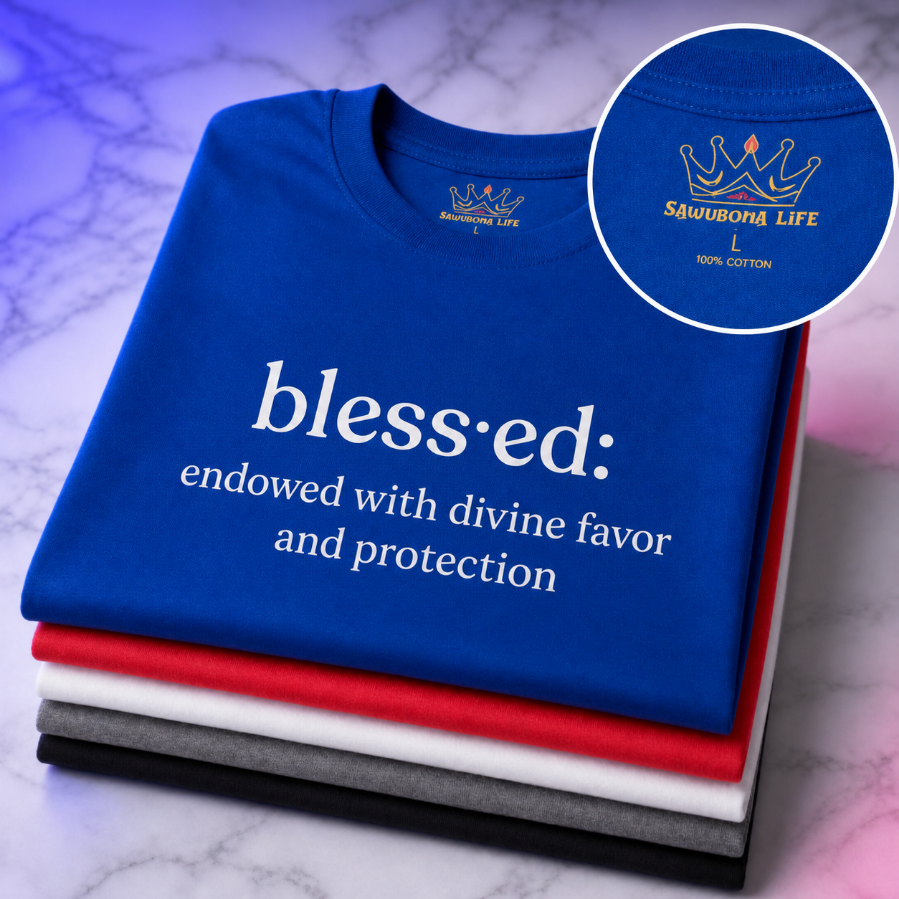
Blessed Graphic Tees Folded - Affirmation Apparel by Sawubona Life
Understanding Sensory Processing and Clothing Comfort
Sawubona, we see you. If you've ever felt overwhelmed by the scratch of a clothing tag, the tightness of a seam, or the way certain fabrics make your skin crawl, you're not alone.
Sensory processing refers to how your brain receives, organizes, and responds to sensory information from your environment. For some people, this system works in ways that make everyday clothing genuinely painful or distracting. A tag that most people ignore becomes an unbearable itch.
At Sawubona Life, we understand that clothing comfort isn't superficial. It's foundational. When your clothes feel right, you can focus on what matters. You can show up fully in your work, relationships, and life. When they don't, you're constantly managing a low-level distraction or irritation that drains your energy and attention.
The good news: tagless clothing sensory processing solutions exist, and they work. Not as a gimmick, but as a practical tool that addresses real sensory challenges.
How Sensory Processing Differences Affect Clothing Comfort
Sensory processing differences change the way your body experiences fabric, fit, and construction details that most people never notice. Your nervous system might be hypersensitive (picking up on subtle sensations others miss) or hyposensitive (needing more input to feel regulated). Either way, clothing becomes a constant negotiation.
When your sensory system is hypersensitive, tags, seams, and certain fabric textures trigger disproportionate responses. Your brain flags these sensations as threats or irritants, and your body responds with discomfort, distraction, or anxiety.
Hyposensitivity works differently. You might need clothing with more texture, weight, or compression to feel grounded. Standard fabrics feel too light or insubstantial. You're constantly adjusting, tugging, or seeking tactile input to feel regulated. This isn't restlessness, it's your nervous system signaling that it needs more sensory input to function optimally.
Both patterns are legitimate. Both affect quality of life. And both respond well to clothing designed with sensory needs in mind. The key is understanding what your specific triggers are, then choosing clothes that eliminate or accommodate them.
Sensory Issues with Clothing Tags and Labels
Tags are the most obvious culprit, and for good reason.
For people with sensory processing challenges, a tag isn't just an inconvenience. It's a persistent signal your nervous system can't ignore. The back of your neck is densely packed with nerve endings. A scratchy label there becomes the dominant sensation of wearing the shirt. You can't stop noticing it.
Some people respond by removing tags entirely, but this creates its own problems. Loose threads, fraying edges, or the absence of size information make the garment feel unfinished or unsafe. Others choose to tolerate the discomfort, which means spending energy managing sensation rather than living their life.
This is where sensory-friendly clothing enters the picture. Brands like Sawubona Life design tagless construction specifically to eliminate this trigger. No tag means no constant irritation, no fraying edges, no visual reminder of discomfort. Just clean seams and a garment that feels intentional.
Common Clothing Triggers Beyond Tags
Tags are the headline, but they're far from the only problem. Understanding the full range of clothing triggers helps you make choices that actually work for your sensory system.
Seams and construction details create significant discomfort for many people.
Fabric weight and texture matter tremendously. Lightweight, slippery fabrics can feel insubstantial or triggering. Heavy, stiff fabrics might feel restrictive or suffocating.
Fit and tightness affect sensory comfort in complex ways. Too tight creates pressure that some people find calming and others find intolerable.
Elastic, waistbands, and closures often contain irritating materials or create uneven pressure. Drawstring pants, tight waistbands, or elastic that digs into skin can make an otherwise perfect garment unwearable.
Dyes, finishes, and chemical treatments on fabric can trigger sensory responses or skin reactions. Some people respond to synthetic dyes, others to stiffening agents or sizing.
The pattern here is clear: standard clothing construction prioritizes durability, cost, and appearance over sensory comfort. When you have sensory processing differences, you need clothing designed with your nervous system in mind.
Why Tagless Clothing Reduces Tactile Discomfort
Tagless clothing sensory processing works because it removes one of the most persistent irritants from the wearing experience. But the benefits go deeper than just "no tag."
When a garment is tagless, you're not managing a constant low-level irritation. Your nervous system isn't sending signals about discomfort every time the tag touches your skin. This frees up mental energy.
Tagless construction also signals intentionality. This usually means they've also paid attention to seam placement, fabric choice, and overall construction quality. Sawubona Life's tagless apparel, for example, combines tagless construction with ultra-soft, premium fabric and thoughtful seam placement.
The reduction in tactile discomfort also has downstream effects on regulation and focus. When your body isn't in low-level distress, your nervous system has resources for other things. You can concentrate at work. You can be present in conversations.
For many people, this shift is profound. Not because tagless clothing is magic, but because it removes a real barrier to functioning well. When your clothes stop fighting you, you have more energy for everything else.
Clothing Sensitivity and Autism
For autistic individuals, sensory sensitivities around clothing are extremely common (‘I feel trapped in my safe clothes’). Many autistic people experience heightened sensory perception, colors are brighter, sounds are louder, and tactile sensations are more intense. A tag that neurotypical people ignore becomes genuinely overwhelming.
Clothing sensitivity autism is recognized as a legitimate sensory processing difference, not a quirk or preference. Autistic people often report that finding wearable clothing is one of the most challenging aspects of daily life.
This is where sensory-friendly design becomes essential. Autistic individuals often benefit from tagless clothing, seamless construction, soft fabrics, and minimal visual or tactile complexity.
Sawubona Life's approach to tagless apparel recognizes this reality. By designing clothing with sensory processing challenges in mind, we create garments that autistic individuals can actually wear without constant discomfort or distraction.
Many autistic adults report that finding clothing that works for their sensory system is transformative. It's not vanity; it's self-care. When your clothes feel right, you have more capacity to navigate a world that isn't always designed for you.
SENSORY COMFORT IS SELF-CARE.
COMFORT IS AS IMPORTANT AS FASHION.
WE SEE AND ACKNOWLEDGE SENSORY CHALLENGES.
Seamless Clothing for Sensory Sensitivity
Beyond removing tags, seamless clothing for sensory sensitivity addresses another major irritant: seam placement and construction. Seams create texture changes, pressure points, and visual complexity that can trigger sensory discomfort.
Seamless garments eliminate seams entirely in key areas. A seamless shirt has no seams down the sides, no seams at the underarm, and no seams creating pressure or friction. This matters tremendously for people whose sensory systems flag seams as irritants.
However, "seamless" is more nuanced than it sounds. Truly seamless garments are expensive and often require specialized construction. More common are "minimal seam" designs that reduce seams in high-irritation areas while maintaining structural integrity.
The choice between seamless and minimal-seam depends on your specific sensory needs and budget. Some people need completely seamless clothing. Others find that minimal seams in low-contact areas work fine.
Sawubona Life's tagless design includes thoughtful seam placement. We understand that removing a tag isn't enough if seams are still creating discomfort. Our construction prioritizes both tagless design and strategic seam placement to minimize tactile irritation.
How to Choose Sensory-Friendly Clothes
Choosing clothing that actually works for your sensory system requires knowing what to look for and being willing to prioritize comfort over other factors.
Start by identifying your specific triggers. Is it tags? Seams? Fabric weight? Tightness? Elastic? Dyes? Different people have different sensory profiles.
Once you know your triggers, look for garments specifically designed to address them. This means reading descriptions carefully, asking manufacturers questions, and being willing to try things.
Fabric content matters significantly. Natural fibers like cotton and bamboo often feel better on sensory-sensitive skin than synthetics.
Color and dye choices can affect sensory experience. Some people find that undyed or naturally dyed fabrics feel better on their skin. Others are fine with synthetic dyes. Again, this is individual.
Look for brands that understand sensory needs and design specifically for them. Sawubona Life creates apparel with sensory processing in mind.
Finally, give yourself permission to prioritize comfort absolutely. If a garment doesn't feel right, it doesn't matter how good it looks or how much it cost. Your sensory comfort is non-negotiable.
Fabric Choices That Support Sensory Comfort
Cotton is a reliable choice for sensory-sensitive people. It's breathable, soft, and doesn't create the static or slickness that some synthetics do.
Bamboo and bamboo blends offer a silky, ultra-soft feel that many sensory-sensitive people prefer. Bamboo fabric is hypoallergenic, breathable, and has a luxurious texture.
Modal and micromodal are semi-synthetic fibers made from wood pulp. They're incredibly soft, drape well, and feel gentle on sensitive skin. Modal blends are common in sensory-friendly apparel.
Avoid synthetic blends unless you've tested them on your skin. Polyester, nylon, and other synthetics can feel slippery, create static, or trap heat in ways that trigger sensory discomfort.
Weight and weight distribution matter. Lightweight fabrics can feel insubstantial or triggering. Medium-weight fabrics usually offer a better sensory experience.
Texture and finish vary widely. Some fabrics are smooth and slick; others have a subtle texture. Some are brushed or napped, creating a softer surface.
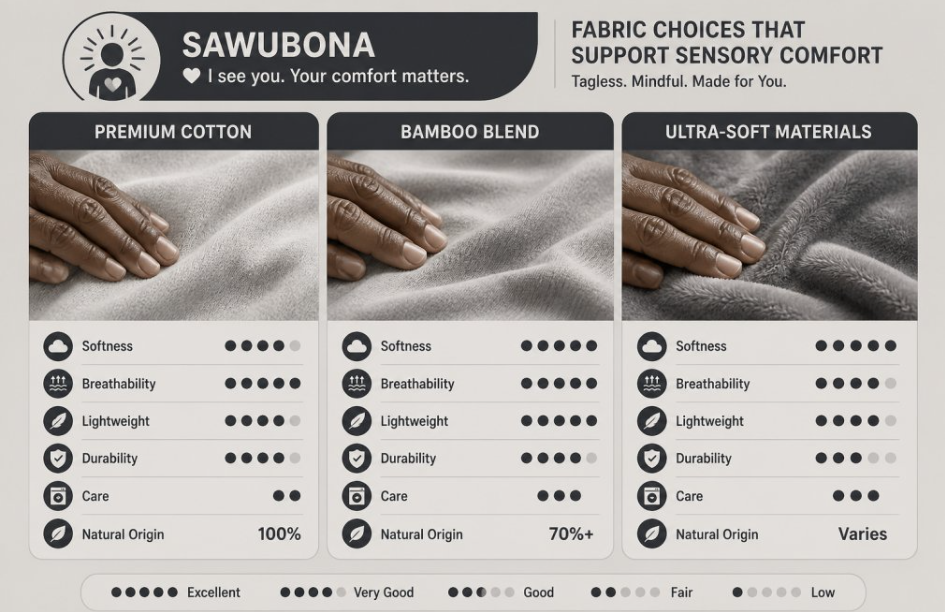
Infographic Comparing Soft Fabric Textures for Tagless Clothing Sensory Processing Comfort
Sawubona Life prioritizes fabric quality and sensory experience. Our apparel uses premium, ultra-soft materials chosen specifically for their sensory properties. We understand that fabric choice is foundational to sensory comfort.
Tagless Construction Methods: What Actually Works
Not all tagless construction is created equal. Understanding the different methods, and their sensory trade-offs, helps you know what you're actually getting and whether it will work for your specific sensory profile.
Printed labels are the most common approach. Instead of a woven tag sewn into the garment, the size and care information is printed directly onto the fabric using heat-transfer or direct-to-fabric printing.
Heat-transfer or embroidered labels place information on the exterior of the garment rather than sewn inside. This keeps the interior completely smooth and free of any texture.
No-label or hang-tag construction eliminates permanent labels entirely.
Integrated or woven labeling embeds information directly into the fabric structure itself, sometimes through weaving the size or brand name into the knit or weave pattern.
Evaluating tagless methods for your sensory profile:
If your primary irritation is from tags touching your neck or inner body, printed labels or no-label construction work well.
Test one method before committing to multiple garments. A printed label that doesn't bother one person might create noticeable texture for another.
Sawubona Life uses construction methods that prioritize sensory comfort and transparency.
Clothing Comfort and Emotional Regulation
The connection between physical comfort and emotional regulation is real and measurable. When your body feels comfortable, your nervous system has more resources for regulation. When your clothing is creating constant low-level distress, your capacity for emotional regulation decreases.
This is particularly true for neurodivergent people. Autistic individuals, people with ADHD, and others with sensory processing differences often rely on external tools to support regulation. Comfortable clothing is one of those tools.
When you wear clothing that feels right, several things happen. Your nervous system isn't sending distress signals. Your body feels safe and supported. You have mental energy available for other things.
Sawubona Life's approach to apparel recognizes this. Our tagless, ultra-soft clothing is designed to support your nervous system. We also integrate mindfulness tools through our subtle sleeve QR codes, which connect to resources for mental wellness.
The philosophy here is simple: your presence is essential and valid. Clothing that honors your sensory needs and supports your regulation is part of affirming that worth.
A Practical Transition Plan to Tagless Clothing
Phase 1: Test and Track (Weeks 1-2)
Choose one tagless item, ideally a basic t-shirt in a fabric you think you'll like. Wear it for short periods in low-stress situations: at home, during a quiet activity, or for an hour while doing something you enjoy. After wearing it, note:
How does the fabric feel on your skin? (Soft, scratchy, too heavy, too light, just right?)
Does the fit feel right? (Too tight, too loose, pressure points, comfortable?)
Does the absence of a tag make a noticeable difference? (Can you forget about it, or are you still aware of the garment?)
Any unexpected irritation? (Seams, elastic, dyes, heat buildup?)
Use a simple tracking sheet or phone note. You're building a sensory profile, not judging the garment.
Phase 2: Expand and Compare (Weeks 3-4)
If the first piece works, add a second item.
Phase 3: Test Across Settings (Weeks 5-8)
Once you've found one or two pieces that work, wear them in different contexts: at work, during social activities, while exercising, or during stressful situations. Sensory comfort can vary by context. A fabric that feels perfect at home might feel different when you're anxious or moving around. Track:
How does the garment perform in different environments?
Does it hold up through the day, or does discomfort build over time?
How does it feel after washing? (Fabric can change texture after the first wash.)
Does it support your regulation, or does it feel neutral?
Phase 4: Intentional Replacement (Month 3+)
As your standard clothing wears out, replace it with tagless options that work for you.
For caregivers and supporters:
If you're helping someone else transition to tagless clothing, involve them in the process.
Use this script when introducing the idea: "I found some clothing without tags that might feel better.
If the person is nonverbal or has difficulty articulating sensory experience, observe behavior: Do they wear the garment repeatedly?
Communicating sensory needs to schools and workplaces:
If sensory clothing is part of your accommodation plan, communicate it clearly. Use this template:
"[Person's name] has sensory processing differences that make standard clothing uncomfortable. Tagless, seamless, or soft-fabric clothing supports their regulation and focus. We are providing [specific garments] as part of their daily routine. Please allow [person] to wear these items as needed."
For school-age children, include this in your 504 plan or IEP accommodation request.
Tracking tool: Simple sensory comfort log
Use this format (digital or paper) to track what works:
Date and garment (e.g., "Bamboo t-shirt, Sawubona Life")
Context (home, work, school, social)
Comfort rating (1-5 scale)
Notes (fabric feel, fit, seams, any irritation, how long worn)
Would wear again? (Yes / No / Maybe with adjustment)
Over time, patterns emerge. You'll notice that certain fabrics, weights, or construction methods consistently work, while others don't.
Permission to be selective:
Throughout this process, give yourself permission to be selective. Not every tagless garment will work for you.
Sawubona Life's apparel is designed to work for sensory-sensitive people, but individual sensory profiles vary widely. Testing is always wise.
What Customers Say About Tagless Comfort
Real people report real changes when they switch to sensory-friendly, tagless clothing. These aren't marketing claims, they're lived experiences.
T. Avon shared: "I have somewhat sensitive skin, so finding shirts that do not irritate me is a boon.
A. Meza reported: "I am absolutely in love with my shirts from Sawubona Life! The fabric is super soft, durable, and they fit perfectly true to size.
T. Williams noted: "I grabbed a few shirts from Sawubona Life and they've been solid. The fabric feels soft and good quality, and they've held up fine after washing. Fit is true to size and comfortable for regular wear. Will be shopping again." Durability and repeated wear matter when you finally find clothing that works for your sensory system.
These aren't isolated experiences. People with sensory processing challenges report that finding clothing that actually works is life-changing. Not because the stakes are high, but because clothing is unavoidable. When you finally have options that don't trigger discomfort or distraction, you can focus on your actual life.
Frequently Asked Questions
How can tagless clothing help with sensory processing?
Tagless clothing eliminates one of the most common tactile triggers: scratchy labels and tags that dig into skin, cause itching, or create constant distraction. For people with sensory processing sensitivities, even a small tag can trigger discomfort, anxiety, or sensory overload throughout the day. Removing this irritant allows you to focus on daily activities without the distraction of physical discomfort, which can improve concentration, reduce stress, and support emotional regulation.
What is the relationship between autism and sensitivity to clothing?
Autistic individuals often experience heightened tactile sensitivity due to differences in how their nervous systems process sensory input. Many autistic people report that clothing tags, seams, tight fits, and certain fabric textures cause significant discomfort, irritation, or sensory overload. This isn't a preference; it's a neurological difference that affects how the brain processes touch sensations. Sensory-friendly clothing, including tagless options, can reduce these barriers and make getting dressed a calmer, more comfortable experience.
Can clothing tags cause sensory overload?
Yes. For people with sensory processing challenges, a persistent irritant like a tag can accumulate sensory input throughout the day, contributing to overall sensory load. A tag scratching skin, creating pressure points, or catching attention repeatedly can trigger or worsen sensory overload, leading to anxiety, fatigue, difficulty concentrating, or withdrawal from activities. Removing tags eliminates this constant low-level irritant and reduces the total sensory burden.
What should adults look for in sensory-friendly clothes?
Look for tagless construction, flat seams or seamless designs, soft natural fabrics like cotton or bamboo blends, and a fit that doesn't restrict movement or create pressure points. Pay attention to fabric weight and texture. Heavier, structured fabrics can feel restrictive, while ultra-soft materials tend to feel calming. Test fit carefully, as sizing and comfort vary by brand. Consider how the garment feels against your skin during movement, not just when standing still, and prioritize your specific sensory needs over marketing claims.
How do I transition to tagless clothing if I'm used to regular clothes?
Start by introducing one tagless piece at a time and wear it for short periods to gauge comfort. Pay attention to how different fabrics and fits feel throughout the day. Layer tagless pieces under or over clothes you already trust while you adjust. Keep notes on which styles, fabrics, and fits feel best for your body and sensory needs. Gradually increase wear time and add more pieces as you identify what works. This slow approach reduces overwhelm and helps you build a sensory-friendly wardrobe that actually fits your life.
Are tagless clothes worth the investment compared to regular clothing?
The value depends on how much sensory discomfort affects your daily life. If tags, seams, or fabric textures cause significant distraction, anxiety, or avoidance of activities, removing these barriers can meaningfully improve your quality of life, focus, and emotional well-being. Quality tagless clothing tends to hold up better through washing and wearing, reducing replacement frequency. Beyond durability, the peace of mind and comfort support, especially for neurodivergent individuals or those with chronic sensory challenges, often justify the investment in pieces designed specifically for your needs.
What fabrics work best for sensory sensitivity?
Soft, breathable natural fibers like 100% cotton, bamboo blends, and organic materials are often preferred by people with sensory sensitivities. These fabrics typically feel smooth against skin, allow air circulation to prevent overheating, and are less likely to create irritation. Avoid synthetic blends that can feel scratchy, trap heat, or create static. Test fabrics in person if possible. What feels soft to one person may feel irritating to another. Weight also matters: lighter fabrics often feel less restrictive, while heavier materials can feel grounding and calming depending on individual preference.
The Bottom Line: Sensory Processing Comfort as Self-Care
Sensory processing differences shape how you experience the world, and clothing is one of the most immediate and unavoidable sensory inputs you encounter.
Finding clothing that works for sensory-sensitive bodies has historically meant compromise: sacrifice style, accept limited options, or tolerate constant discomfort. Sawubona Life changes that equation.
Tagless clothing sensory processing solutions address this directly. By removing tags, choosing premium fabrics, and paying attention to construction details, brands like Sawubona Life create garments that work for sensory-sensitive bodies. This isn't a niche feature; it's a foundational design.
Your sensory comfort matters. Your nervous system's needs are valid. Clothing that honors both is self-care in its most practical form. When you wear something that feels right, you're affirming your own worth and creating space for regulation and presence.
Sawubona Life's tagless apparel combines sensory-friendly design with premium, ultra-soft fabric and intentional construction. Our garments serve as an everyday anchor for your mental wellness journey, reminding you that your presence is essential. Shop our collection and discover clothing that actually works for your sensory system.
YOU ARE VALUED.
YOUR COMFORT IS PARAMOUNT.
SAWUBONA LIFE IS HERE FOR YOU.